What Is the Best Laser Metal Cutting Machine in 2026?
Choosing the best Laser Metal Cutting Machine in 2026 is not simply a matter of buying the highest-wattage laser. The right choice depends on material, thickness, cut quality, production volume, and the people who will run it. A machine cutting stainless-steel panels all day has different needs from one handling occasional aluminum brackets. Small details matter: assist-gas use, loading time, extraction, and access to local service. There is no universal winner.
Market trends help explain why buyers are comparing more than cutting speed. Grand View Research’s Laser Cutting Machines Market report estimated the global market at about US$6.8 billion in 2023 and projected continued growth through 2030. Meanwhile, the International Federation of Robotics’ World Robotics 2024 report recorded 4,281,585 industrial robots operating worldwide in 2023, up 10% from 2022. These figures point to expanding investment in automation, but they do not prove that every shop needs a fully automated cutting cell. That distinction is easy to miss.
This guide compares machine types and practical selection criteria, including fiber-laser power, bed size, supported metals, software, safety features, and total operating costs. It also considers setup, maintenance, and supplier support, because a fast machine can still lose valuable hours when production stops. Specifications deserve scrutiny. Published cutting speeds often depend on ideal conditions, and real results vary with material and process settings. The best choice is the one that fits your workload reliably, not merely the one with the biggest number on its brochure.
How Fiber and CO₂ Lasers Cut Metal: 1.06 μm vs. 10.6 μm
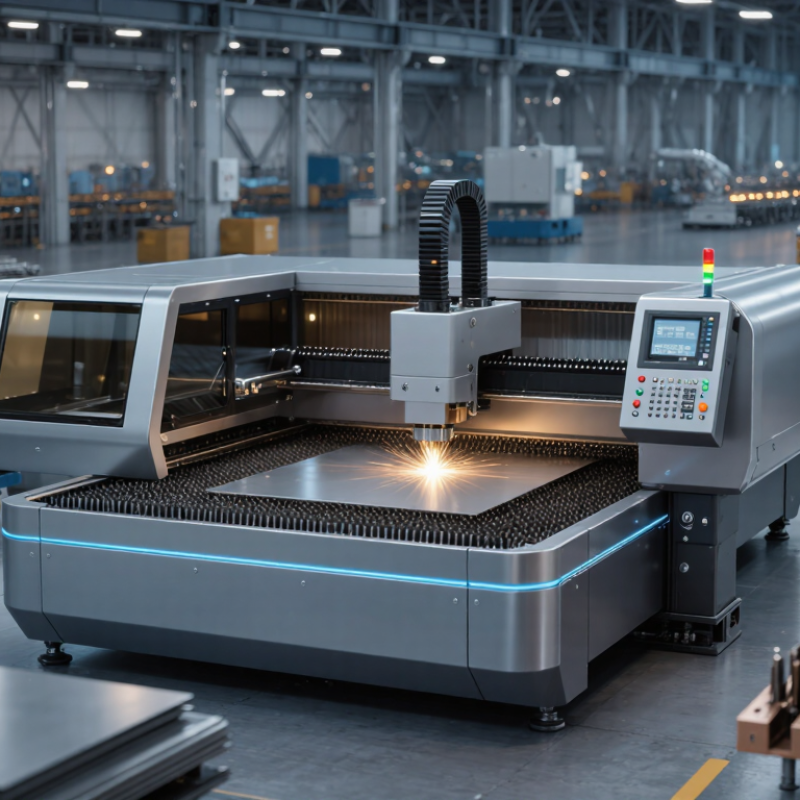
For metal cutting, wavelength changes how the workpiece absorbs energy. Fraunhofer ILT’s laser-processing data place common fiber sources near 1.06–1.07 μm and CO₂ lasers near 10.6 μm. Using Planck’s relation and constants in NIST’s 2022 CODATA adjustment, those wavelengths correspond to photon energies of about 1.17 eV and 0.117 eV. That is a tenfold difference. It does not mean a fiber laser automatically cuts ten times faster.
Many metals couple more readily with near-infrared fiber-laser light, especially once a cut begins and the beam enters the kerf. CO₂ light can be reflected more strongly by some clean metal surfaces, so initial coupling may be less efficient. Results still depend on alloy, surface condition, thickness, focus, assist gas, and cutting speed. A shiny aluminum sheet and an oxidized steel plate are not equivalent tests. That matters.
For a shop comparing systems, inspect cut-edge samples at the actual material thickness, not only the power rating. Industry process data show why wavelength is a useful starting point, not a complete buying rule. Fiber systems often suit thin-to-medium sheet production, while CO₂ systems can remain capable on particular materials and setups. I would treat any simple “best wavelength” claim cautiously; nozzle condition and gas pressure can spoil an otherwise sound comparison.
What Machine Power Means: Compare 3–30 kW Fiber Laser Systems
A 3–30 kW rating describes the laser’s output power, not a guaranteed cutting thickness or finished-edge quality. A 3 kW fiber system may suit frequent work with thin sheet and moderate production volumes. Around 6–12 kW, shops often gain speed and capacity across a broader range of sheet and plate. Higher-power systems, including 20–30 kW machines, can improve throughput on thicker materials, but results depend on the machine and process setup. Power is only one variable.
Compare machines using the materials and thicknesses you actually cut. Ask for sample cuts in your common grades, then inspect the edge, burr, small holes, and cycle time. No single number tells the whole story. Assist gas, nozzle condition, focus settings, motion control, and material quality all affect results. Published capacity charts are useful, but they are not a substitute for a realistic test.
More power can also mean higher equipment, electrical, cooling, and operating demands. If most orders involve thin stainless or mild steel, a 30 kW source may add cost without useful gains. I would be cautious about choosing by maximum speed alone; it is easy to overvalue a dramatic demonstration. That judgment can be wrong for a rapidly changing shop. Match the power range to today’s workload, while checking whether expected future jobs justify the added capacity.
How Material and Thickness Affect Cutting Speed, Kerf, and Edge Quality
What Is the Best Laser Metal Cutting Machine in 2026?
How Material and Thickness Affect Cutting Speed, Kerf, and Edge Quality
Material and thickness determine whether a laser’s rated power becomes useful cutting speed. Thin stainless steel can cut quickly, but excess heat may discolor edges or widen the kerf. On a 1 mm sheet, a narrow kerf helps preserve small slots; a slight focus error can still leave burrs. Small details matter.
Thicker mild steel needs more energy and usually slower travel. Assist gas changes the result: oxygen can increase cutting speed on some steels, while nitrogen often produces a cleaner, less oxidized edge. That cleaner finish may require more gas, so compare operating costs as well as cycle time. There is no universal setting.
When assessing a machine, ask for test cuts using your actual material, thickness, and smallest feature. Check the cut face under bright light, measure kerf width, and note dross on the underside. A specification sheet cannot show every real-world variation. Even a good test may not match every production sheet, which is worth remembering.
How to Assess Cut Quality Using ISO 9013 Tolerances
When comparing a laser metal cutting machine in 2026, advertised speed tells only part of the story. ISO 9013 provides a practical framework for judging thermal-cut quality, including perpendicularity or angularity tolerance and mean profile height. These values describe the cut edge, not the machine’s full performance. Small distinctions matter.
Cut a test coupon from the same alloy and thickness as your daily work. Record assist gas, focus position, feed rate, and sheet condition; otherwise, the comparison is difficult to repeat. After cooling, inspect several locations rather than choosing the cleanest corner. Use suitable gauges or profile-measurement equipment to assess edge deviation and roughness against the ISO 9013 range relevant to that thickness and process.
A machine that holds the chosen tolerance across long cuts may suit production better than one with a fast, flawless short sample. Check dross, bevel, and heat tint too, since tolerance alone does not show cleanup needs. Results can still vary with setup, which is easy to underestimate. Treat one coupon as evidence, not proof.
How to Choose a 2026 Machine by Capacity, Safety, and Operating Cost
The best laser metal cutting machine in 2026 is the one that fits your actual workload, not the largest model in a catalog. Start with the metals you cut, their maximum thickness, and the sheet sizes you handle each week. A machine that regularly cuts near its rated capacity may produce slower work and less consistent edges. Check sample cuts, including corners and small holes, before choosing.
Safety and operating cost deserve equal attention. Look for a fully enclosed cutting area, working interlocks, clear emergency stops, and suitable fume extraction. Confirm that operators can access routine service points without awkward reaching. Then estimate electricity, assist gas, consumables, maintenance, and downtime. Rated cutting speed alone can mislead; real output depends on material, setup, and operator skill. One detail is easy to miss: a cheaper machine may cost more when parts or support take weeks to arrive.
Tips: Ask for a timed test using your own material and thickness. Request a written list of included safety features and routine maintenance needs. Compare useful parts per shift, not just maximum speed. Keep a little capacity in reserve. It may feel wasteful at first, but crowded production plans leave little room for mistakes.