Top PET Tape for Journals Which Is Best?
PET Tape For Journals can add crisp color, clean borders, and glossy details to a spread. But “best” depends on how you journal. A narrow roll may suit date boxes, while a wider design can frame a photo or cover a page edge. Clear PET tape keeps writing and paper visible beneath its pattern. Opaque prints make stronger accents, but can hide small notes. Small details matter.
When comparing tapes, look at print sharpness, backing material, roll width, and how easily the tape separates from its liner. Check whether the adhesive feels secure on your paper, especially near curved corners or frequently handled pages. A smooth, coated journal page may behave differently from textured paper. Product descriptions help, but they cannot predict every surface. A small test strip is useful.
There is a trade-off. Some tapes lift cleanly, while others may leave residue or disturb delicate paper if pulled too quickly. And a beautiful roll can still be awkward to use. Try a short piece before decorating a full spread; press it down gently, then check the edges after a day. Compare options by the details you actually need, not just the packaging. This guide will help you weigh practical features and choose PET tape that suits your journal, materials, and style.
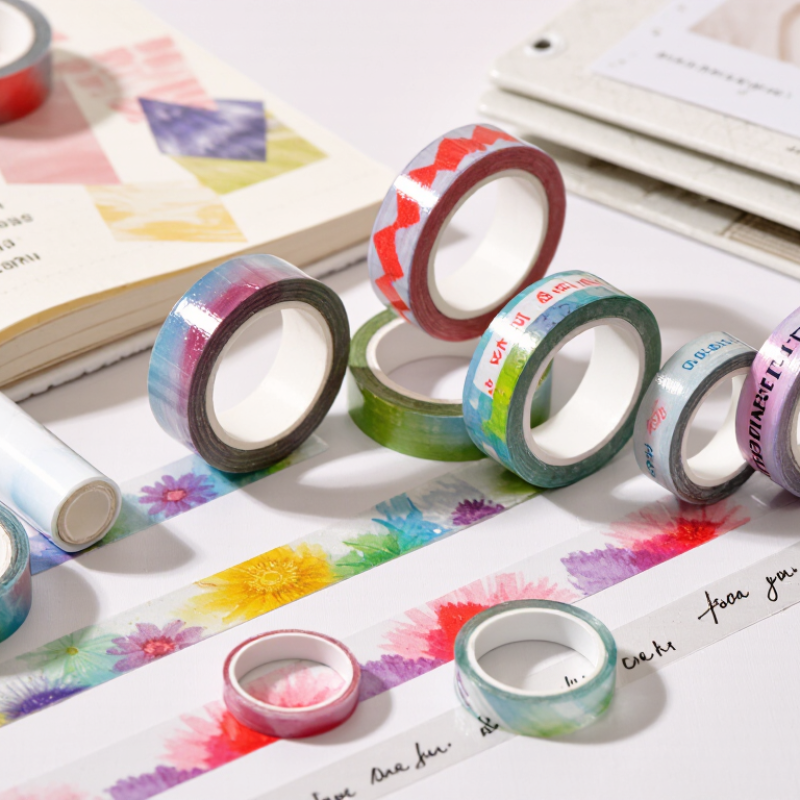
PET Journal Tape Basics: Polyester Film, Adhesive Layers, and 12–50 μm Carriers
PET journal tape uses a polyester film carrier, often called PET, to provide a thin, smooth backing. Carrier thickness commonly ranges from 12 to 50 μm; this describes the film, not the finished tape. Adhesive layers add thickness and determine how the tape feels, sticks, and lifts. Thin film bends easily around page edges, while thicker film can feel firmer under a fingertip. Neither is automatically better.
The adhesive may be acrylic or another pressure-sensitive formulation. Its performance depends on the paper surface, coating, and storage conditions. On a smooth planner page, a small strip may lie flat; on textured paper, edges can catch lint or lift. Test an inconspicuous corner before covering a drawing or writing. A simple check.
For journaling, look at carrier clarity, adhesive consistency, and how cleanly the tape cuts. Hold a sample over fine handwriting: haze or glare can make letters harder to read. Then press it onto scrap paper and peel it back slowly. Some papers tear even when the adhesive is mild. I would not judge tape by thickness alone; the backing and adhesive work as a system, and product descriptions do not always explain their combined thickness.
Top PET Tape for Journals Which Is Best? - PET Journal Tape Basics: Polyester Film, Adhesive Layers, and 12–50 μm Carriers
| Tape construction | PET carrier thickness | Typical adhesive layer | Approx. total tape thickness | Typical properties | Journal use and selection guide |
| Clear PET with permanent acrylic adhesive | 12–25 μm | About 10–25 μm, single-sided | About 22–50 μm | Transparent film preserves the visibility of printed designs. Acrylic adhesives generally offer good aging and light resistance. | Suitable for layering over illustrations, labels, and page decorations. Choose a thinner carrier for a flatter feel; test first on delicate or coated paper. |
| Printed or translucent PET with permanent acrylic adhesive | 16–36 μm | About 10–25 μm, single-sided | About 26–61 μm | Printed graphics sit on a durable film carrier. The film may feel smoother and less paper-like than paper-based decorative tape. | Useful for borders, motifs, and decorative accents. Check opacity and print coverage if the writing or page color beneath should remain visible. |
| Matte-finish PET with permanent acrylic adhesive | 25–50 μm | About 10–25 μm, single-sided | About 35–75 μm | A matte surface reduces the glossy appearance; the thicker carrier is generally more substantial and may be easier to handle. | Good for bold accents and labels. The matte finish does not guarantee that every pen or marker will adhere, so test ink compatibility before writing on it. |
| Thin PET with removable or repositionable acrylic adhesive | 12–25 μm | About 10–25 μm, single-sided | About 22–50 μm | Designed for easier repositioning than many permanent tapes. Removability depends on the adhesive, paper surface, pressure, and time in place. | Consider for temporary layouts and movable page elements. Always test on the intended paper; “removable” does not mean damage-free on every surface. |
| Double-sided PET tape | 12–50 μm | About 10–30 μm per side | About 32–110 μm, excluding any release liner | Adhesive is applied to both sides of the PET carrier. A release liner protects one adhesive face before use. | Useful for attaching lightweight paper pieces or embellishments. Select a narrow width and low-profile construction when minimizing bulk is important. |
How to read the figures: Thickness values are indicative construction ranges, not a product specification. Total thickness is an approximate sum of the PET carrier and adhesive layer(s); it excludes any release liner. Actual values, tack, removability, and paper compatibility vary by formulation and supplier.
How PET Tape Is Made: Film Thickness and ASTM D3652 Measurement
Top PET Tape for Journals: How Film Thickness Is Measured
PET tape combines a polyester backing with a pressure-sensitive adhesive. Its thickness affects how smoothly it sits on a journal page. A thin strip can follow a curved edge neatly, while a thicker layer may feel raised beneath a fingertip. The total thickness includes both backing and adhesive, so the film’s thickness alone does not describe the finished tape.
ASTM D3652/D3652M, the standard test method for pressure-sensitive tape thickness, specifies controlled measurement procedures for comparing samples. A calibrated gauge and consistent contact conditions help reduce variation. For example, a 50-micrometre PET backing with a 20-micrometre adhesive layer would have a nominal combined thickness of 70 micrometres. That is an illustration, not a universal product specification. A single reading is not enough.
For journal use, compare measurements taken across several points and record whether the figure refers to the PET film or the complete tape. Small differences can matter at overlaps: two layers may create a noticeable ridge near a page edge. Thickness also cannot predict everything; adhesive tack, release behavior, and paper texture influence handling. ASTM’s method offers a repeatable basis for comparison, but real page tests still reveal details a gauge misses.
Top PET Tape for Journals: Which Is Best?
Illustrative PET film gauges and their nominal thickness in micrometers.
How to read this: The bars show example film-gauge values, not measurements of specific products. ASTM D3652 is a method for measuring pressure-sensitive tape thickness; a finished tape’s measured thickness includes its backing and adhesive, so it can differ from the PET film gauge alone.
How to Compare Tack, Peel, and Shear: ASTM D6195, D3330, and D3654
For journal PET tape, “sticky” is not a useful measurement by itself. ASTM D6195 measures loop tack: the quick grab when a tape loop touches a surface. ASTM D3330 measures peel adhesion, commonly reported as force per tape width. ASTM D3654 measures holding power under a sustained load, indicating resistance to creep. These methods separate three jobs: catch the page, peel away cleanly, and stay put. They do not establish one universal best tape.
Compare actual lab reports, not just product claims. A useful data sheet states the method, tape width, backing, test surface, dwell time, conditioning, and peel angle or applied load. For example, a 180-degree peel result on stainless steel cannot be treated as a direct prediction of performance on a coated journal page. Small details matter. A longer dwell can change adhesion; paper texture and ink can change removal behavior. ASTM International’s D6195, D3330, and D3654 methods provide repeatable test frameworks, but the measured values belong to the stated conditions. I would shortlist tapes with balanced tack and peel, then check shear under a realistic page load. One caveat: a clean steel result may still disappoint on paper.
How Paper Coatings and Porosity Affect PET Tape Adhesion
Top PET Tape for Journals: Which Is Best?
How Paper Coatings and Porosity Affect PET Tape Adhesion
PET tape adhesion depends on the paper beneath it, not just the adhesive. On smooth, coated journal pages, tape can make broad contact with the surface. Yet some coatings contain pigments or sizing that reduce how readily adhesive grips. Uncoated paper is often more absorbent and fibrous. Its pores can draw adhesive away from the surface, while loose fibers may lift during removal. The result can feel counterintuitive: rough paper may offer texture, but not necessarily stronger adhesion. That matters.
Tips: Test a small strip on the actual page. Press it down with a fingertip, then check the edge after a day. Avoid judging adhesion from a glossy sample alone.
For a useful comparison, record the paper type, coating, dwell time, and peel force. ASTM D3330 and FINAT FTM 1 are established pressure-sensitive tape peel-test methods; results are commonly expressed as force per 25 millimeters of width. These methods support repeatable comparisons, but they do not set one universal “best” PET tape value for every journal paper. I still find quick fingertip tests easy to misread. A tape that holds firmly may also pull fibers when removed, so test both adhesion and clean release before decorating a finished page.
Which PET Tape Suits Journaling: Clarity, Writable Surfaces, Residue, and Roll Specs
For journal pages, clarity matters more than a glossy first impression. Hold a sample over printed lines: good transparency keeps small text readable and colors close to their original shade. Some PET films add a slight haze, especially over pale paper. Check the tape under your usual desk light, not just on a product screen. Tiny differences show.
Writable surfaces need a closer look. A slick PET face may repel gel ink or smear felt-tip marks, while a coated surface can accept writing more reliably. Test your actual pen, then let the ink dry before touching the page. Pencil may leave faint marks. That is not always a defect; it depends on the finish and your journaling style. Try a short strip first.
Adhesive residue varies with the paper, pressure, and how long the tape stays in place. On delicate pages, lift a corner slowly before committing to a full border. Roll specs matter, too: narrow widths suit labels and slim accents, while wider rolls cover headers quickly. Compare roll length and core size with your storage space. A neat-looking roll can still be awkward to use.