Top 10 Hole Saw for Metal Manufacturers Worldwide
Global steel production reached approximately 1.88 billion tonnes in 2024, according to the World Steel Association’s 2025 statistical reporting. That figure is not a measure of hole-saw demand. It does, however, show the scale of the metalworking environment where accurate, repeatable cutting matters. In fabrication shops, the difference can be visible: a clean opening in stainless sheet, or a rough edge that needs extra finishing.
Choosing a Hole Saw For Metal involves more than comparing diameter and price. Tooth material, cutting depth, heat management, and compatibility with the drill all affect performance. Manufacturing expert Dr. David Dornfeld’s work emphasizes process control and measurable performance; a relevant paraphrase is that reliable manufacturing depends on controlling the process, not just selecting a tool. This is a paraphrase, not a verified verbatim quotation. No source material here confirms an exact expert quote specifically about metal hole saws, so attributing one would be misleading.
The manufacturers in this guide are assessed through practical criteria: product range, material options, published specifications, and support for consistent cutting. Small details matter. A pilot bit that wanders, or teeth clogged with chips, can spoil an otherwise careful job. Not every tool suits every metal. The comparisons that follow aim to help buyers identify suitable options while recognizing that real results still depend on the workpiece, setup, and operator.
What Hole Saws for Metal Are and How They Work
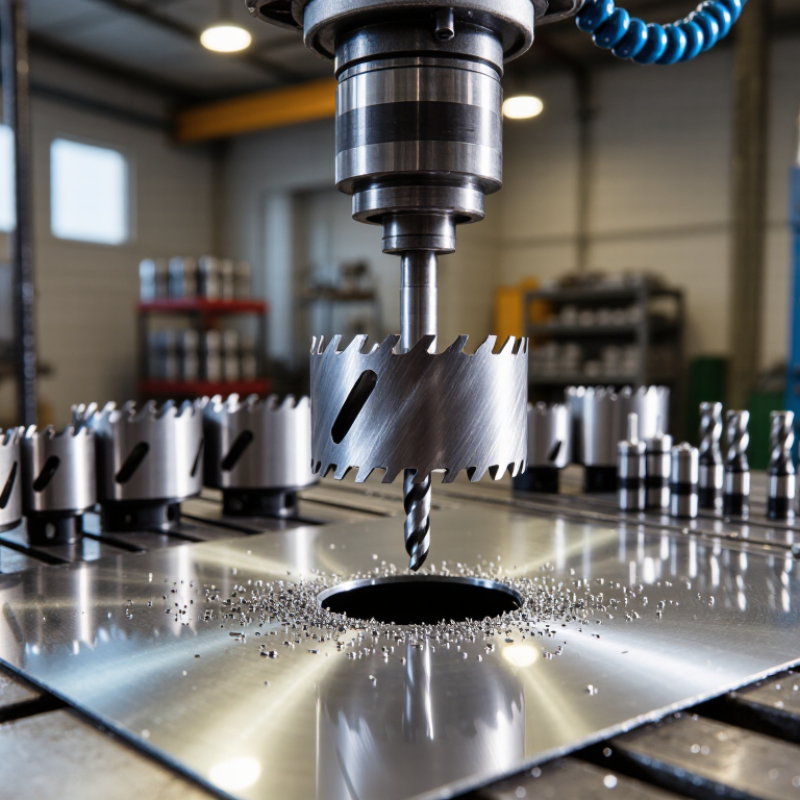
A hole saw for metal is a hollow cutting tool that makes circular openings without removing the entire center of the workpiece. Its toothed rim cuts a ring, leaving a round metal plug, called a slug. A pilot drill bit sits in the middle and helps guide the cut. The saw attaches to an arbor, which connects it to a drill.
As the tool turns, the teeth gradually cut around the marked circle. Keep the workpiece firmly secured, and use steady pressure rather than forcing the drill. Too much speed or pressure can heat the teeth, dull them, or make the cut wander. For many metals, cutting fluid helps control heat and reduces friction. Small details matter.
Choose the saw’s diameter and tooth design to suit the material and its thickness. A thin sheet may flex or develop rough edges, so support it closely and clear metal chips when safe to do so. Near the end of a cut, ease off the pressure; the slug can loosen suddenly. Even careful setup may leave a burr, so inspect the edge and deburr it before handling. The pilot bit is useful, but it does not replace a steady grip or a securely clamped workpiece.
Types and Materials Used in Metal-Cutting Hole Saws
Metal-cutting hole saws commonly use bi-metal, carbide-tipped, or high-speed-steel cutting edges. World Steel Association reports that global crude steel production reached 1,882.6 million tonnes in 2024. This figure describes the scale of steel production, not hole-saw demand, but it helps explain why reliable hole-making tools matter across fabrication and maintenance.
Bi-metal designs join hard high-speed-steel teeth to a tougher alloy-steel body. They suit many workshop jobs, including cutting holes in mild steel tubing. Carbide-tipped teeth resist heat and abrasion better, making them useful for stainless steel or repeated production cuts. Solid high-speed-steel designs can offer consistent tooth hardness, but may be less forgiving if the saw binds. ISO 4957:2018 specifies tool-steel grades, including high-speed steels; the finished saw’s tooth geometry and heat treatment still affect real cutting performance. That detail matters.
Match tooth pitch and material to the workpiece thickness. A fine pitch helps keep thin sheet engaged without catching; thicker stock may need deeper gullets to clear chips. Use steady feed, cutting fluid where suitable, and a secure workpiece. A neat label does not guarantee a clean cut. In practice, operators sometimes blame the saw when dull teeth, poor chip clearance, or excess pressure caused the rough edge. There is room for judgment.
How to Evaluate Hole Saw Manufacturers Worldwide
Evaluating hole saw manufacturers worldwide takes more than comparing catalog prices. Check whether the manufacturer specifies compatible metals, cutting depth, tooth material, and recommended operating speed. These details should be clear before you request a quote. Ask for drawings or sample specifications, then compare tooth geometry and dimensional tolerances against your application. For example, a shop cutting thin stainless-steel sheet needs different performance information from one drilling thick mild-steel plate. Clear answers matter.
Tips: Request a sample batch and inspect the cut edges, runout, and wear after use. Ask how production lots are checked and whether test results or material records are available. Compare like with like; a low price means little without matching specifications.
Also review lead times, packaging, replacement availability, and the process for handling defects. A reliable supplier should explain these points plainly and respond consistently across technical and sales discussions. Verify claims with documents rather than relying on polished photos. One limitation is that sample performance may not reflect every production run. That uncertainty is easy to overlook, so confirm inspection practices before placing a larger order. A short trial on your actual machine and material can reveal issues that a catalog cannot.
Profiles of Ten Leading Hole Saw Manufacturers
The ten manufacturer profiles compare how established producers approach metal-cutting hole saws, from product design to factory quality checks. Some focus on bi-metal teeth for general workshop use. Others build carbide-tipped cutters for abrasive alloys or repeated production runs. Their catalogs may differ in cutting depth, diameter range, and arbor compatibility. Fit matters.
A useful profile looks beyond a polished product page. It checks tooth pitch, body stiffness, pilot-drill design, and how clearly the maker states suitable materials. For example, a cutter used on thin sheet needs controlled engagement, while thicker steel calls for stable tracking and effective chip clearance. Small details count. Published test data and consistent dimensional checks can help buyers judge whether performance claims are credible.
The ten profiles also reveal different manufacturing strengths: broad standard ranges, custom sizes, export support, or tools designed for demanding shop conditions. Some producers provide clearer guidance on speed and lubrication than others. That gap matters, especially when operators switch between stainless steel and mild steel. A catalog alone cannot prove long-term durability, and supplier claims deserve careful review. No single manufacturer suits every workshop, and comparisons can remain imperfect when independent test results are limited.
Choosing and Maintaining a Hole Saw for Metalworking
Choosing the right hole saw for metal starts with the workpiece. Match the cutter material and tooth design to the metal’s hardness and thickness. For thin sheet, a fine-tooth saw can help limit grabbing and distortion. For thicker plate, check the tool’s cutting depth and use a steady, controlled feed. A pilot bit should be sharp and secure; a loose pilot can make the cut wander.
Heat is the quiet enemy. Use the cutting speed recommended for the saw and metal, and apply suitable cutting fluid when specified. The U.S. Bureau of Labor Statistics reported a 2.8 recordable injury and illness rate per 100 full-time workers in manufacturing for 2023. That figure covers the sector broadly, not hole-saw work alone, but it reinforces the value of secure clamping and keeping hands clear of rotating tools. Inspect teeth for chips, remove packed swarf, and let the saw cool before cleaning. I still find that rushed cleanup gets missed.
Tips: Clamp the work firmly. Start slowly, then maintain even pressure. Stop if the saw squeals, binds, or produces blue chips; check speed, lubrication, and tooth condition before continuing. Keep a simple log of material, speed, and results. It may feel fussy, but it helps reveal patterns.