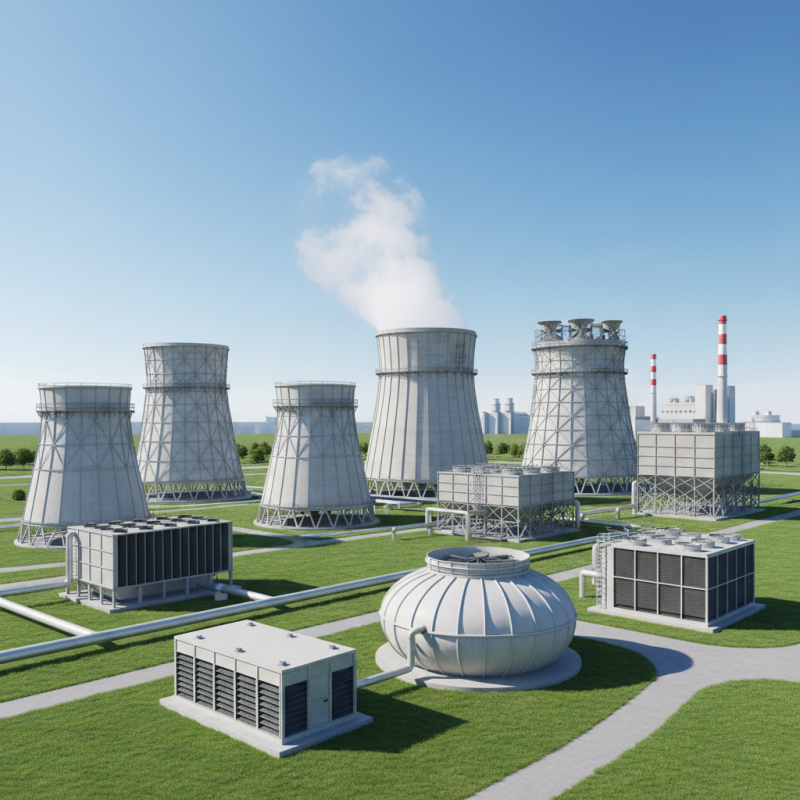
Top 10 Cooling Tower Types You Should Know About?
cooling towers play a crucial role in various industries. They help dissipate excess heat from processes and equipment. Understanding different types of cooling towers is essential for effective cooling solutions.
With advancements in technology, cooling towers have evolved significantly. Each type offers unique benefits and drawbacks. Selecting the right one can be challenging for many.
There are many factors to consider. For instance, efficiency and maintenance can vary greatly. The right cooling tower can enhance productivity, but the wrong choice may lead to inefficiencies. Knowing the top 10 types will guide you to make informed decisions.
Types of Cooling Towers: An Overview of Industry Standards and Applications
Cooling towers play a crucial role in industrial applications. They help dissipate heat from various systems. Understanding different types can enhance operational efficiency.
There are two main categories: open and closed cooling towers. Open cooling towers utilize evaporation, which cools water directly exposed to the air. This method can be efficient, but it may have issues with water quality due to contamination.
Closed cooling towers offer better protection. Water circulates through coils, minimizing exposure to the environment.
Choosing the right type is essential for specific applications. Factors to consider include water quality, environmental conditions, and maintenance needs. Each type has benefits and drawbacks. For example, while open systems may be cost-effective initially, they can lead to higher maintenance costs over time. In contrast, closed systems can be expensive but reduce risks associated with contamination. Analyzing these elements is crucial for optimal performance.
Natural Draft vs. Mechanical Draft Cooling Towers: Key Differences Explained
When discussing cooling towers, the distinction between natural draft and mechanical draft is essential. Natural draft cooling towers rely on buoyancy to circulate air. They use heat to create upward air movement. This method often requires tall structures. Their height allows for effective air intake. However, these towers can be limited by location and weather conditions. They may perform inadequately in low-wind areas.
In contrast, mechanical draft cooling towers utilize fans to move air. These fans can be adjusted for efficiency. This technology allows for better control of cooling performance. Mechanical draft towers work well in various environments. However, they can be costlier to operate due to energy consumption. The choice between these two types can be complex. Consider factors like space, operating costs, and environmental impact. Each system has its strengths and weaknesses that must be evaluated.
Crossflow and Counterflow Cooling Towers: Efficiency and Design Comparisons
Cooling towers are vital for many industrial processes. They help remove excess heat. Among the various types, crossflow and counterflow cooling towers stand out. Their designs impact efficiency and performance.
Crossflow cooling towers have a unique design. Water flows down while air moves horizontally. This design enhances air exposure. It may lead to better cooling at lower pumping costs. However, crossflow towers can be more challenging to maintain. The open structure collects debris easily, requiring frequent cleaning.
Counterflow cooling towers operate differently. Water cascades down as air rises through the structure. This design helps maintain high efficiency and can save space. However, counterflow towers may be more complex to construct. Their operation can sometimes lead to noise issues and additional energy consumption. Balancing these factors is crucial for choosing the right type of tower.
Comparison of Cooling Tower Types: Efficiency and Design
This chart illustrates the efficiency ratings and design characteristics of various types of cooling towers, specifically Crossflow and Counterflow types. The data is based on operational metrics commonly used in the industry.
Closed-Circuit Cooling Towers: Benefits and Industry Usage Statistics
Closed-circuit cooling towers (CCCTs) are becoming increasingly popular in various industries. They offer advantages like efficient heat transfer and reduced water consumption. According to the Cooling Technology Institute, CCCTs can cut water usage by up to 95% compared to open systems. This significant reduction appeals to industries facing water scarcity issues.
In power generation and manufacturing sectors, the statistics show a growing inclination towards CCCTs. A recent industry report noted that over 40% of new installations in these sectors are closed-circuit systems. These towers not only save water but also minimize the risk of contamination. This feature is crucial in processes requiring high purity standards, such as pharmaceuticals.
However, while the benefits of CCCTs are notable, they are not without flaws. Initial setup costs can be high, deterring some businesses. Maintenance can also be demanding, requiring regular inspections. Companies must weigh these aspects against the operational savings. Understanding both the advantages and challenges is vital for those considering a closed-circuit cooling solution.
Hybrid Cooling Towers: Combining Technologies for Optimal Performance
Hybrid cooling towers are emerging as a vital solution in industrial applications. They integrate both wet and dry cooling technologies. This combination enhances efficiency while reducing water consumption. An industry report indicates that hybrid cooling towers can decrease water use by up to 30% compared to traditional models. This is crucial in water-scarce regions where conservation is paramount.
These towers offer versatility in performance. In colder months, dry cooling is more effective. Conversely, in warmer seasons, the wet cooling process shines. This adaptability leads to optimal thermal performance year-round. Data from various case studies show a significant reduction in operational costs over time.
Tips: Regular maintenance is key. Inspecting fans, pumps, and drift eliminators can ensure maximum efficiency. Consider monitoring water quality closely. Scaling and fouling can impede performance. Evaluation of operational parameters every few months can reveal performance gaps.