© 2025 Messer Cutting Systems, Inc.

A Hydraulic Pallet Truck may look simple: two forks, a handle, and a small pump. Yet the wrong choice can mean strained operators, damaged pallets, or a truck that struggles on a rough warehouse floor. Buyers should compare rated capacity, fork dimensions, turning space, wheel material, handle comfort, and maintenance access. Details matter. A few centimeters can decide whether the forks enter a pallet cleanly.
The U.S. Bureau of Labor Statistics reported 2.6 million nonfatal workplace injury and illness cases in private industry during 2023. That figure is not specific to pallet trucks, but it underlines why safe material handling deserves careful attention. The report offers context, not proof that one truck design prevents injuries. Buyers should also check manufacturer specifications and test a loaded truck on the actual route, including thresholds and tight corners. One overlooked factor? The floor. A smooth showroom tells little about a cracked loading bay. This guide presents seven practical buying tips, while acknowledging that budget and operating conditions can pull in different directions. There is no perfect truck.
A named expert quotation is not included because no verifiable quote or source material was provided. Inventing one would weaken a buying guide that should rely on traceable evidence. Use these tips as a starting point, then confirm each specification with the supplier before purchase.
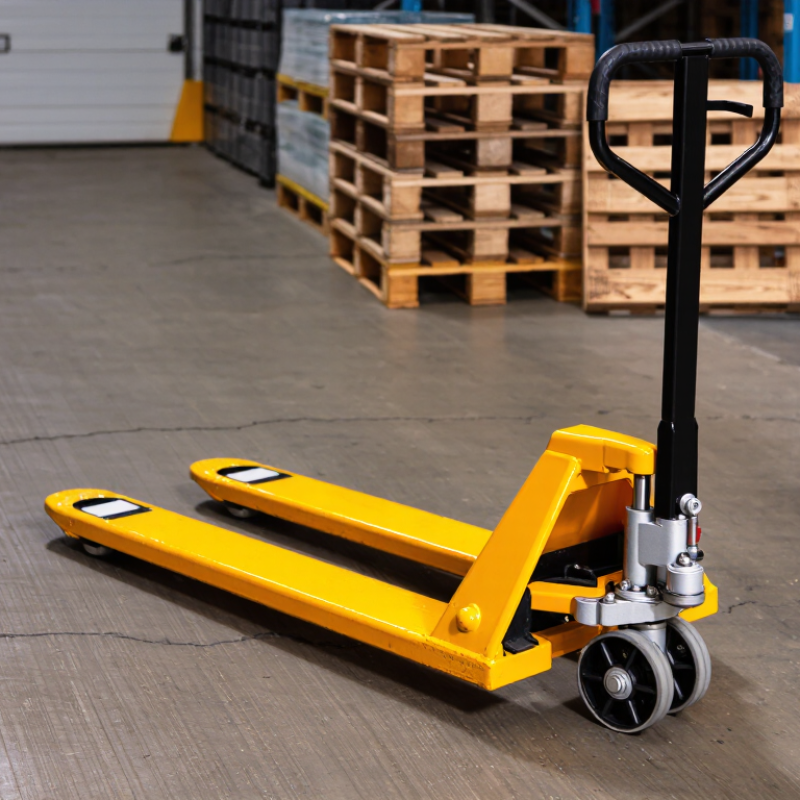
A hydraulic pallet truck should be rated for the heaviest load you actually move, not just your typical shipment. Check the truck’s rated capacity and compare it with the combined weight of the pallet and goods. Keep the load’s position in mind, too: weight concentrated near the pallet tips can affect handling. Leave a practical margin rather than choosing a truck that only just meets your estimate. Measure twice.
Pallet dimensions matter just as much as weight. Record the pallet’s length, width, and entry direction, then check fork length, outside fork width, and the space between the forks. A standard-looking pallet may still have unusual openings or a damaged bottom board. Measure the narrowest aisle and the tightest doorway on the route. Even careful measurements can miss a turning constraint, so test the truck in the actual workspace when possible.
Tips: Bring a loaded pallet’s measurements to the supplier, including any overhang. Confirm that the forks enter fully and support the load evenly. If several pallet sizes are used, check compatibility with each one; the largest pallet is not always the trickiest. Recheck measurements before ordering. It can feel repetitive, but replacing an unsuitable truck is worse.
| Tip | What to Check | Practical Guidance | Example Requirement |
|---|---|---|---|
| 1. Establish the heaviest load | The combined weight of the pallet and its contents—not just the product weight. | Choose a truck with a rated capacity that meets or exceeds the heaviest expected load. Never exceed the truck’s rating; follow the load plate and operating instructions. | For a maximum loaded pallet of 1,800 kg, consider a truck rated for at least 1,800 kg, subject to the manufacturer’s stated conditions. |
| 2. Check how the load is distributed | Whether the load is centered and evenly supported across the forks. | A long, uneven, or off-center load can affect stability and safe handling. Confirm capacity limits for the actual load arrangement with the truck supplier. | Position a centered, evenly distributed load across both forks rather than allowing most of its weight to sit at one end. |
| 3. Measure pallet length and width | The pallet’s outside dimensions and the direction from which the forks enter. | Measure several pallets if sizes vary. Confirm that the fork length and spacing suit the pallet’s entry openings and provide appropriate support. | A common European pallet measures 1,200 × 800 mm; verify its entry direction and underside clearance before selecting a truck. |
| 4. Match fork length to the pallet | Fork length, pallet depth in the entry direction, and the support needed for the load. | A 1,150 mm fork length is a common option for handling many standard 1,200 mm-long pallets from the appropriate entry side, but the fit must be checked for the specific pallet and load. | For a pallet with approximately 1,200 mm of depth in the fork-entry direction, check whether 1,150 mm forks provide the required support. |
| 5. Confirm fork outside width and spacing | The truck’s overall fork width and the clear spacing between its forks. | Compare these measurements with the pallet’s openings, runners, and blocks. Forks must enter freely and support the pallet without fouling its structure. | A narrow pallet may need a different fork arrangement from a wider pallet; check the manufacturer’s drawing against the measured pallet underside. |
| 6. Check pallet entry and clearance | Fork-entry openings, bottom-board height, and the truck’s lowered fork height. | Confirm that the forks can enter and exit without striking the pallet. Low-profile pallets may require a truck designed for reduced fork height. | Measure the clearance beneath the pallet’s entry openings and compare it with the truck’s lowered fork height. |
| 7. Verify the complete operating route | Aisle width, turning space, floor condition, slopes, and any tight doorways. | Compare the truck’s overall dimensions and turning requirements with the narrowest parts of the route. Use the truck only on surfaces and gradients permitted by its instructions. | Measure the narrowest aisle and doorway, then confirm the selected truck can maneuver through them with the intended pallet. |
Dimensions and capacity examples are for planning only. Confirm the truck’s rated capacity, fork configuration, and operating limits with its technical specifications before purchase.