© 2025 Messer Cutting Systems, Inc.

Choosing the best Warehouse Racking System in 2026 starts with a less glamorous question: what must your operation store, move, and retrieve each day? A narrow-aisle layout may fit more pallet positions, but it can also require specific trucks and tighter operating discipline. Selective pallet racks offer direct access to every load. Drive-in racks increase density, yet reduce selectivity. There is no universal winner. The wrong fit shows up in blocked aisles, slow picks, and pallets that cannot be reached when demand shifts.
Warehouse expert Edward Frazelle, author of World-Class Warehousing and Material Handling, has said, “The warehouse is the last frontier of cost reduction.” That idea makes rack selection more than a construction decision. It connects storage space with labor, equipment, inventory flow, and future growth. Start with real measurements: clear height, aisle widths, pallet dimensions, load weights, and daily pick patterns. Then compare those facts against the system’s trade-offs. Safety and inspection planning matter, too; a bent upright is not a cosmetic detail. Small details count.
This guide compares common rack types and explains where each one can work well. It also considers automation, flexibility, installation, and total operating cost. Forecasts are imperfect. A system designed only for today’s peak volume may become an expensive constraint. The best choice is the one that fits current work while leaving room for change—though even careful plans deserve regular review.
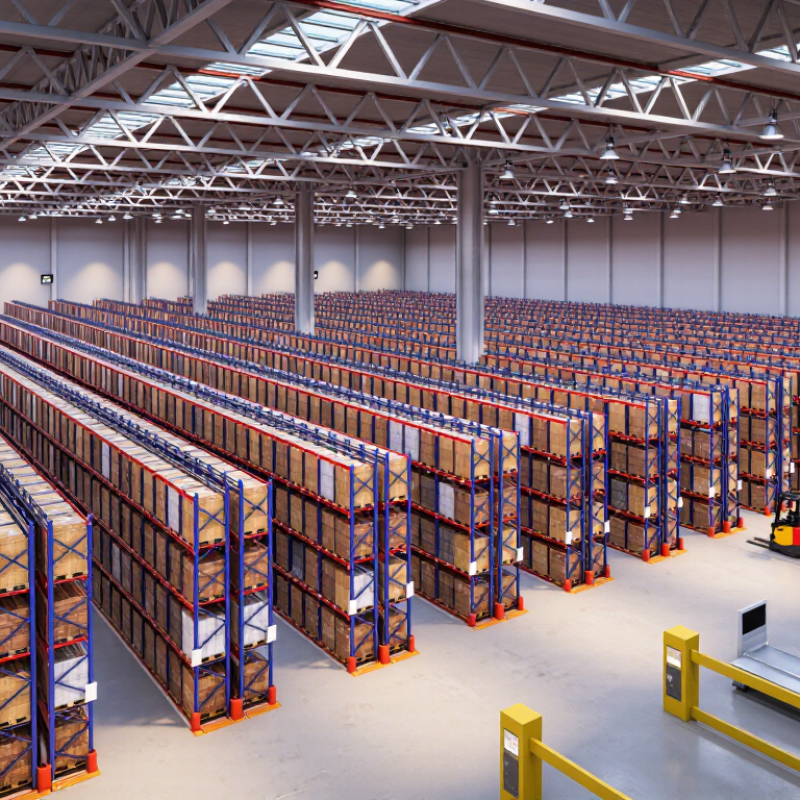
Warehouse racking is a storage structure, but its layout also shapes how people and equipment move. Selective pallet racks keep each pallet accessible, making them useful when products vary often. Drive-in racks reduce aisle space and suit larger batches of similar goods, though workers cannot reach every pallet as directly. Cantilever arms hold long items, such as pipes or timber. Small cartons may fit better on shelving or flow racks.
The right system depends on what is stored: load weight, pallet dimensions, turnover, and picking method all matter. Check clearances, too. A forklift needs room to turn, and a beam must match the actual load. Nearly right is not right enough. A rack plan that looks efficient on paper can create daily bottlenecks if fast-moving goods sit deep inside a dense layout.
Technology increasingly affects warehouse handling. MHI’s 2024 Annual Industry Report found that 46% of surveyed supply-chain professionals were using robotics and automation. That figure does not mean every warehouse needs automated storage; it does highlight the value of planning racks around handling equipment and inventory data. A basic rack can work well, but only when inspections, load limits, and placement rules stay current. That takes routine attention. A detail can be missed.
Warehouse racking in 2026 includes several distinct systems, each suited to different inventory and picking needs. Selective pallet racking gives direct access to every pallet, making it useful for warehouses with many product lines. It is easy to adjust, but its aisles can consume valuable floor space. Double-deep racking stores pallets two positions deep and increases density; reach equipment and stock rotation need closer planning.
Drive-in and drive-through racks place pallets on rails within deep lanes. They suit larger batches of similar goods, though access is less flexible. Push-back systems use nested carts, allowing several pallets per lane while keeping loading and retrieval at the front. Pallet-flow racks use inclined rollers to move stock forward. They can support first-in, first-out rotation, but product dimensions and pallet condition matter. Small details matter.
Cantilever racking holds long items such as pipes, timber, or metal sections without front columns. For cartons and hand-picked goods, shelving or carton-flow racks may be more practical than pallet storage. Mobile racking moves rows to open an aisle, trading fast access for higher storage density. A site plan can make any option look tidy. Measure clear heights, aisle widths, load weights, and handling equipment before deciding; missed sprinkler clearances or awkward picking routes can change the answer.
Compare common racking types by typical storage density and pallet selectivity.
Scores are illustrative planning ratings on a 1–5 scale, not measured specifications. Selective racks prioritize direct access to every pallet; drive-in and mobile systems can increase storage density, but site layout, inventory turnover, equipment, and safety requirements affect the best choice.
Warehouse racking selection starts with the load, not the aisle layout. Record each pallet’s weight, dimensions, and load distribution. Then confirm the rated capacity with a qualified supplier, including beam and upright limits. Do not treat a high total capacity as permission to overload one shelf. Small details matter.
Accessibility affects how quickly staff can reach stock. Selective racks provide direct access to every pallet, but require more aisle space. Drive-in or push-back layouts can store more pallets within a footprint, yet restrict access to individual loads. For products with fast turnover or frequent variety, that trade-off may increase handling time. It depends.
Compare the full installed cost, not just the rack price. Include floor preparation, installation, inspections, equipment needs, and future changes. Measure clear height, column positions, doorways, sprinklers, and turning space before choosing a system. A layout that looks efficient on paper can feel cramped when a forklift carries a long pallet. Leave some room for change; forecasts are rarely perfect.
| Racking System | Capacity and Storage Density | Accessibility and Selectivity | Relative Cost | Space Use | Best Fit | Main Trade-Off |
|---|---|---|---|---|---|---|
| Selective pallet rack | Low to moderate density; each pallet position is independently accessible. | Very high. Forklifts can reach individual pallet loads directly. | Low to moderate; a common baseline for comparison. | Uses wider aisles than most high-density systems, but is straightforward to reconfigure. | Warehouses with many SKUs, frequent picking, or mixed inventory. | Lower storage density because access aisles occupy floor space. |
| Double-deep rack | Moderate density; stores pallets two positions deep. | Moderate. The rear pallet is less accessible and usually requires a reach truck with a pantograph or similar attachment. | Moderate; equipment and operating requirements can add cost. | Reduces the number of access aisles compared with single-deep selective rack. | Operations with multiple pallets per SKU and sufficient inventory depth. | Rear loads are not directly accessible until front loads are moved. |
| Drive-in / drive-through rack | High density; pallets are stored several positions deep in forklift-accessible lanes. | Low to moderate. Loads within a lane are generally handled in sequence. | Moderate; the rack structure can be extensive, while fewer aisles may reduce space-related costs. | High floor-space use because the system minimizes access aisles. | Large quantities of a small number of SKUs, especially where full-lane or batch handling works. | Lower selectivity and greater care needed when forklifts enter the rack structure. |
| Push-back rack | High density; multiple pallets are stored deep on inclined carts or rails. | Moderate. Each lane typically holds one SKU, with pallets accessed from the aisle in last-in, first-out order. | Moderate to high compared with basic selective rack. | Uses fewer aisles while keeping loading and retrieval at the front face. | Operations seeking compact storage with several pallets per SKU and LIFO-compatible inventory. | Not suited to strict first-in, first-out rotation; moving components require maintenance. |
| Pallet flow rack | High density; gravity rollers move pallets through deep lanes. | High for FIFO flow: pallets are loaded at one end and retrieved at the other. | High; rollers, controls, and lane design add to the system cost. | High storage density, though separate loading and retrieval aisles are required. | High-throughput operations with date-sensitive goods or consistent FIFO requirements. | Needs suitable, consistent pallet loads and careful lane design and maintenance. |
| Mobile pallet rack | High density; rack rows move to open an access aisle where needed. | Moderate. Loads are accessible when the required aisle is opened. | High; powered bases, controls, safety equipment, and installation increase investment. | Very high floor-space use because fewer permanent aisles are needed. | Storage-heavy facilities with limited floor area and lower access frequency. | Access is less immediate than with fixed aisles, and powered equipment needs servicing. |
How to interpret the comparison: “Capacity” and “space use” describe typical relative characteristics, not guaranteed pallet counts. Actual capacity depends on the building, aisle width, pallet dimensions, load weights, clear height, fire protection, and local design requirements. Relative costs are directional only; obtain layout-specific quotations and have rack capacity and safety requirements reviewed by qualified professionals.
The best warehouse racking system depends on how goods move through the building. A facility handling many different pallets may value direct access to every load. Selective pallet racking can support that pattern, though it may use floor space less densely. Operations storing fewer product types in larger quantities might consider higher-density options. The trade-off is access: some systems make individual pallets harder to reach. Check product dimensions, pallet weights, order frequency, aisle widths, and forklift turning space before comparing layouts. A drawing can look efficient. A busy shift may tell a different story.
Tips: Track pallet movements for several weeks before choosing. Note peak periods, not just average days. Measure clear ceiling height and inspect floor conditions. Ask a qualified racking professional to review load requirements and the proposed layout.
Leave room for change. Seasonal inventory, new picking methods, or different equipment can make a once-sensible layout awkward. Mark proposed aisles on the floor and test the turning path with the actual forklift. Watch where operators pause or travel around obstacles. Those small delays matter. It is easy to overestimate storage density and underestimate daily access needs; even careful planning can miss a workflow detail. Check that the final design includes suitable load notices and protection where equipment could strike uprights.
In 2026, the best warehouse racking system is the one that fits the building, inventory, and daily handling risks—not simply the one with the highest stated capacity. Before comparing layouts, measure clear height, aisle width, floor condition, sprinkler clearance, and the turning path of loaded equipment. Small mismatches matter. A forklift mast can clip a beam during a tight turn, while an overloaded or poorly anchored frame may deform after repeated impacts. Specify load limits for each bay and level, and display them where operators can read them. Have a qualified rack designer verify loads, slab suitability, seismic exposure, and required clearances against applicable standards. Do not assume an existing floor is adequate.
Technology should improve visibility without adding fragile complexity. Sensors can flag impacts or unusual movement; cameras and warehouse software can help track inspections, locations, and maintenance. Yet alerts help only when someone owns the response. Test whether devices work around metal structures, dust, and busy radio traffic, and check how data is stored and backed up. A connected system is not automatically safer. Compare selective racking with higher-density options by asking how quickly staff can reach damaged pallets, inspect uprights, and isolate a questionable bay. That trade-off is easy to underestimate. Leave room for future changes in pallet sizes and handling equipment, even if the initial layout seems less space-efficient. Reassess the design once real operating patterns emerge.
© 2025 Messer Cutting Systems, Inc.